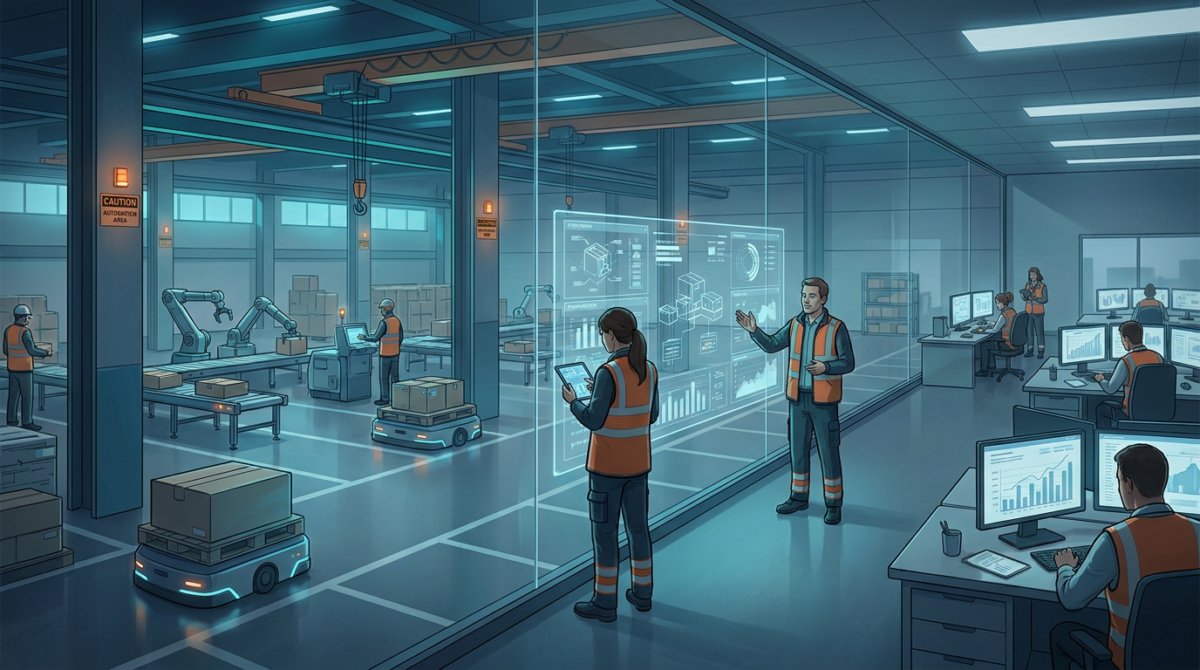
AI is changing warehouse operations by improving inventory accuracy, picking efficiency and demand forecasting. For UK warehouse and inventory managers, the value comes from using AI in a controlled way that supports stock control, reporting and compliance rather than replacing sound processes.
What AI can do in warehouse environments
AI in warehouse management usually means software that spots patterns, predicts demand and recommends actions inside a WMS or related system. Oracle says the main warehouse use cases are order fulfilment and inventory management, including product placement, picking patterns, robots, at-risk orders, demand forecasting and inventory optimisation.[1]
In practical terms, that can include:
- Smarter slotting, so fast-moving items sit closer to dispatch[1][2]
- Better pick-route planning to reduce walking time[2]
- Demand forecasts that help set reorder points and stock levels[1][2]
- Predictive maintenance alerts for equipment faults[1]
- Identification of slow-moving, overstated or at-risk stock[1][7]
The important point is that AI works best when it is layered onto a reliable operational model. If your stock records, item master data and process discipline are weak, AI will usually amplify the weakness rather than fix it.
Why UK warehouses are adopting AI
The business case is usually a mix of lower error rates, faster fulfilment and better use of space and labour. Oracle, Infor and Element Logic all point to improvements in accuracy, productivity, stock visibility and operational efficiency as the main outcomes of AI-enabled warehousing.[1][2][12]
For UK operations, that matters because warehouses are often balancing tight margins, service-level pressure and labour constraints. AI can help teams:
- Reduce stockouts and overstocking through better forecasting[1][2]
- Improve pick accuracy and order speed[1][2]
- Use space more effectively through data-led slotting[1][12]
- Plan labour and automation around demand patterns[12][14]
- Detect equipment anomalies earlier, reducing downtime[1][7]
A useful way to think about AI is as a decision-support layer. It does not remove the need for experienced warehouse management; it improves the quality and speed of decisions.
Where to start: a practical implementation plan
A successful AI rollout usually starts with a narrow use case and a measurable target. That might be reducing mis-picks, improving forecast accuracy or cutting cycle count variance.
Use this step-by-step approach:
- Define the problem in operational terms, such as “reduce stock discrepancies by 20%”.
- Clean your data, including SKU records, locations, units of measure and lead times.
- Confirm your WMS, ERP and barcode processes are consistent.
- Choose one use case, such as demand forecasting or slotting, before expanding.
- Set baseline KPIs for comparison, including pick rate, stock accuracy and order lead time.
- Pilot the process in one site, zone or product family.
- Review results with operations, finance and IT before scaling.
This sequence matters because AI models depend on structured, timely and accurate data. If item codes are duplicated, locations are inconsistent or stock adjustments are poorly controlled, the outputs will be unreliable.
How AI supports stock control and inventory accounting
For UK managers, stock control is not just an operational issue. It affects reporting, auditability and the accuracy of inventory values in the accounts. UK businesses preparing accounts under UK GAAP need robust inventory records, and companies also need records that support statutory filings and internal controls.
AI can support this by:
- Flagging unusual stock movements for review
- Prioritising cycle counts for high-value or high-variance items
- Highlighting items with repeated adjustments
- Improving demand planning so inventory levels are less volatile
- Helping identify obsolescence or slow-moving stock earlier
That said, AI should not be treated as a substitute for controls. It is better used to focus human attention on exceptions, while the core stock ledger remains governed by documented processes, approvals and reconciliations.
Compliance and governance considerations in the UK
UK warehouse teams should introduce AI with clear ownership, documented logic and human oversight. That is especially important where AI influences stock valuation, replenishment or customer commitments.
Good practice includes:
- Keeping a clear audit trail for system recommendations and overrides
- Separating operational suggestions from authorised stock movements
- Testing model outputs against known stock scenarios
- Reviewing how data is stored, accessed and updated
- Making sure teams understand when to trust the system and when to intervene
If AI outputs affect reporting or inventory valuation, finance should be involved early. If the system touches customer data or worker monitoring, governance and privacy checks should be part of the project plan from the start.
Common pitfalls to avoid
AI projects in warehouses often fail for practical rather than technical reasons. The most common problems are poor data quality, unrealistic expectations and weak process discipline.
Watch out for these issues:
- Launching AI before fixing barcode, location or master-data errors
- Choosing a use case without a measurable KPI
- Ignoring exception handling and manual override procedures
- Underestimating training needs for warehouse and admin teams
- Treating AI as a one-off software purchase rather than an operating change
- Expanding too quickly before the pilot proves value
Many sources emphasise that the biggest gains come from inventory, fulfilment and forecasting, but those gains depend on disciplined operations and a reliable WMS foundation.[1][12][15]
Building an AI-ready warehouse team
Technology only works when people trust it and know how to use it. Warehouse managers should involve supervisors, inventory controllers, finance and IT from the outset.
A practical training focus should cover:
- Why the AI model is being used
- What data it depends on
- How to validate unusual recommendations
- When to escalate exceptions
- How the process affects KPIs and reporting
That approach reduces resistance and improves adoption. It also helps teams see AI as a tool for better control, not as a threat to their expertise.
Frequently asked questions
Is AI suitable for SMEs as well as larger warehouses?
Yes. Smaller warehouses can use AI for forecasting, slotting and exception reporting without building a full automation programme. The key is choosing one high-value problem and integrating it into existing processes.[10][12]
Do I need a new WMS to use AI?
Not always. Many AI capabilities are layered into existing warehouse management platforms or connected through analytics tools. The real requirement is reliable data and a process that can act on the system’s recommendations.[1][12]
What is the fastest way to prove ROI?
Start with a narrow pilot around a measurable issue such as pick accuracy, stock variance or forecast error. Several industry sources cite gains in efficiency, reduced errors and inventory optimisation as the main ROI drivers.[1][3][9]
Conclusion
Using AI in the warehouse is less about replacing warehouse teams and more about giving them better information, earlier warnings and stronger control. For UK businesses, the best results come from disciplined stock processes, clean data and a focused pilot that supports compliance and operational KPIs.
If you are planning an AI project, begin with one warehouse problem, measure it properly and build from there.
References
- Oracle UK: AI in Warehouse Management — Impacts and Use Cases
- Element Logic UK: Seven powerful benefits of AI in warehouse operations
- Indigo Software: Benefits and applications of AI in intralogistics
- Andy Proctor: AI for warehousing in 2025
- Iron Mountain: Data-driven insight in UK warehousing
- The AI Journal: The increasing role of AI in warehouses and sheds
- Modern Retail: The influence of AI in warehousing
- Coram AI: AI in Warehouse Management (2026 Guide)
- Pallite Group: Practical applications of AI in today's warehouse
- United Storage: The use of AI in warehouses — what are the benefits?
- Gartner Peer Community poll: Most important benefits of using AI in inventory warehouse management
- Infor UK: AI in Warehouse Management | Use Cases and Benefits
- Locus Robotics: AI in Warehouse Operations: 5 Benefits
- VASS Company: Artificial intelligence in warehouses
- Academic paper on integrating artificial intelligence in warehouse operations
